The Craft of Weaving Meaning
How Narrative Philosophy Arose, Evolved, and Became a Form of Redemption
编织意义的技艺
叙事哲学的兴起、演化与救赎本质
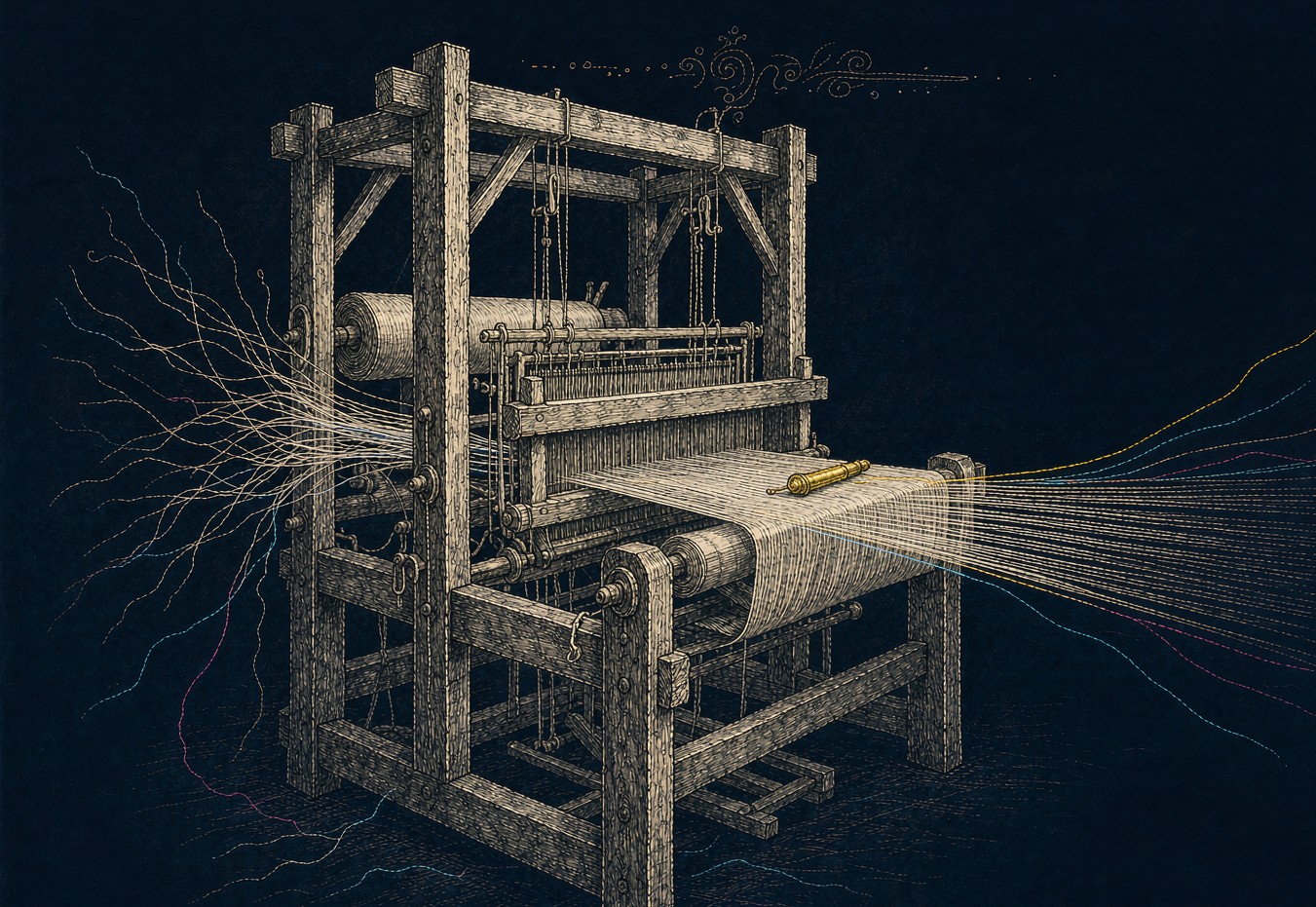
Before asking why 'narrative' has gone sour and slid toward subjectivism, there is a more primitive question to settle first: why do people depend on stories this much? This is not rhetoric — it determines every judgment that follows.
Narrative is not a marketing word invented by modern people, nor a trick freshly grown on social platforms. It is a cognitive apparatus that humanity slowly grew in order to survive a cold, random, chaotic universe. The "narrative turn" that erupted in Western philosophy and sociology in the second half of the twentieth century is rooted right here.
Pull the thread back and you'll find narrative has a separate origin on each of three levels, and they interlock: cognitively it handles chaos for us, psychologically it settles our suffering, socially it fills the vacancy left by religion's withdrawal. These three lines come closer, one by one, to today's trouble.
1. Cognitive evolution: the fever for order and the "imposition of causality"
From the perspective of evolutionary psychology, the brain is first and foremost a pattern-recognition machine. Its main job is not to find truth, but to survive.
In the primal wilderness, those who could not make sense of disorderly natural phenomena did not survive. The fear of "disorder" and "randomness" is written into our genes. To fight it, the brain grew an instinct: impose causality on the world — stitch scattered fragmentary events into a sequence that appears to have cause and effect.
We think we are "discovering" laws, but much of the time we are "installing" them. See lightning then hear thunder, and establish causality; see leaves fall and the air turn cold, and infer the seasons. Correlation gets quietly upgraded to causation.

The structure of a story happens to be "beginning — middle — end," so narrative is the ultimate form of this instinct. The universe itself has no story, only collisions of particles and random motion; it is we who wrap those collisions into stories.
So the first essence of narrative is a psychological defense against the heat-death and entropy of the universe. Without stitching the fragments into a story, a person cannot build any sense of certainty about the world. And of the "laws" you rattle off so readily, how many have you actually verified, and how many are just because you couldn't bear that things are random?
2. The existentialist view: the semantic conversion of suffering and "self-redemption"
If "finding patterns" is about making sense of the outer world, then "telling stories" is about settling the suffering within.
Animals merely endure pain. Humans do more than endure it — they must ask "why do I have to suffer this." Pure, random, reasonless suffering can crush a person's spirit outright.
So narrative offers the semantic conversion of suffering: interpret the torment, failure, and decline before you as "a trial," "a valley," "a stretch of the hero's journey" in the storyline, and the pain instantly takes on a positive meaning. Giving pain a name is often much cheaper than solving it.
A person who can tell their own experience as a story with a beginning and an end that echo each other turns from "a victim being slaughtered by fate" back into "the author of their own story." Without narrative, suffering is just noise; with it, it becomes a dissonant note in a symphony — it exists in order to set off the final harmony.

It is a very effective tool, and precisely because it is so effective, it is easily overused. A person who arranges every pain into "foreshadowing" — when does he ever allow one pain to be just one pain?
3. Social evolution: the dissolution of the sacred grand narrative and the age of "individual screenwriters"
Why the West collectively turned to narrative in the second half of the twentieth century has one more cause at the level of social structure.
3.1 From "God's script" to "the age without a script"
In traditional religious societies, people had no need to invent narratives for themselves. Catholic Genesis and the Last Judgment had already prepared a complete cosmic script for everyone; one only had to play one's role well.
Then the script fell apart. With the advance of modernity and the disenchantment of society, God withdrew and the sacred grand narrative dissolved; family, bloodline, and class — these established orders — were also smashed by industrialization and urbanization.
The script is gone, and people are more exhausted, not less. When was the last time you genuinely felt "no one told me how to live" — at what specific moment?
3.2 Forced to become the "screenwriter" of one's own life
When society's meta-narrative collapses, the individual is thrown into an unprecedented freedom and isolation. Sartre put it most harshly:
Man is condemned to be free.
This line is from Being and Nothingness, 1943. With no ready-made script left, modern people must answer alone "who am I," "where do I come from," "where am I going"; narrative philosophy rose at exactly this moment, handing modern people a substitute to fill the vacuum left by religion's withdrawal.
And so everyone became the exclusive screenwriter of their own life. This is liberation and burden at once — when freedom falls on one person, he has to carry it himself. A person who must write his own script — when there is no audience, does he keep performing?
4. Conclusion: a haven and the starting point of alienation
Looking back, narrative holds a different identity on each of the three lines: cognitively, it is the instinct that sorts chaos and builds order; psychologically, it is the weapon that resists nihilism and completes self-redemption; socially, it is the inevitable choice for the individual to rebuild identity in a post-religious age.
It was originally a haven for sheltering the mind.
But any powerful psychological tool, once over-mined, refined, and put up for sale, can turn into its own opposite. When a society absorbs it quickly and compresses it to an extreme, it slides into subjectivism; when it is fully dissolved into the medium of commerce and algorithms, it becomes the endless "performance of thought" in the society of the spectacle.
Haven and alienation use the very same thing, and there is no warning bell between them. Do you still remember the moment when even a small matter required you to first prepare a ready explanation for yourself?